See the Forest - Not Just the Trees
Abstract
AI is increasingly used in user research to accelerate familiar activities such as summarizing interviews, clustering observations, or generating personas, journey maps, Jobs-to-be-Done analyses, and other research deliverables. While these capabilities can significantly increase productivity, generating each deliverable independently risks creating multiple disconnected views of the same problem space.
Most user research deliverables do not represent fundamentally different knowledge. They organize and expose different perspectives on the same underlying context of use. Tasks, stakeholders, goals, pain points, needs, and the objects people interact with appear across many deliverables, but are structured differently depending on the questions being asked. Generating these perspectives independently therefore creates a need to reconcile information that should originate from the same underlying understanding.
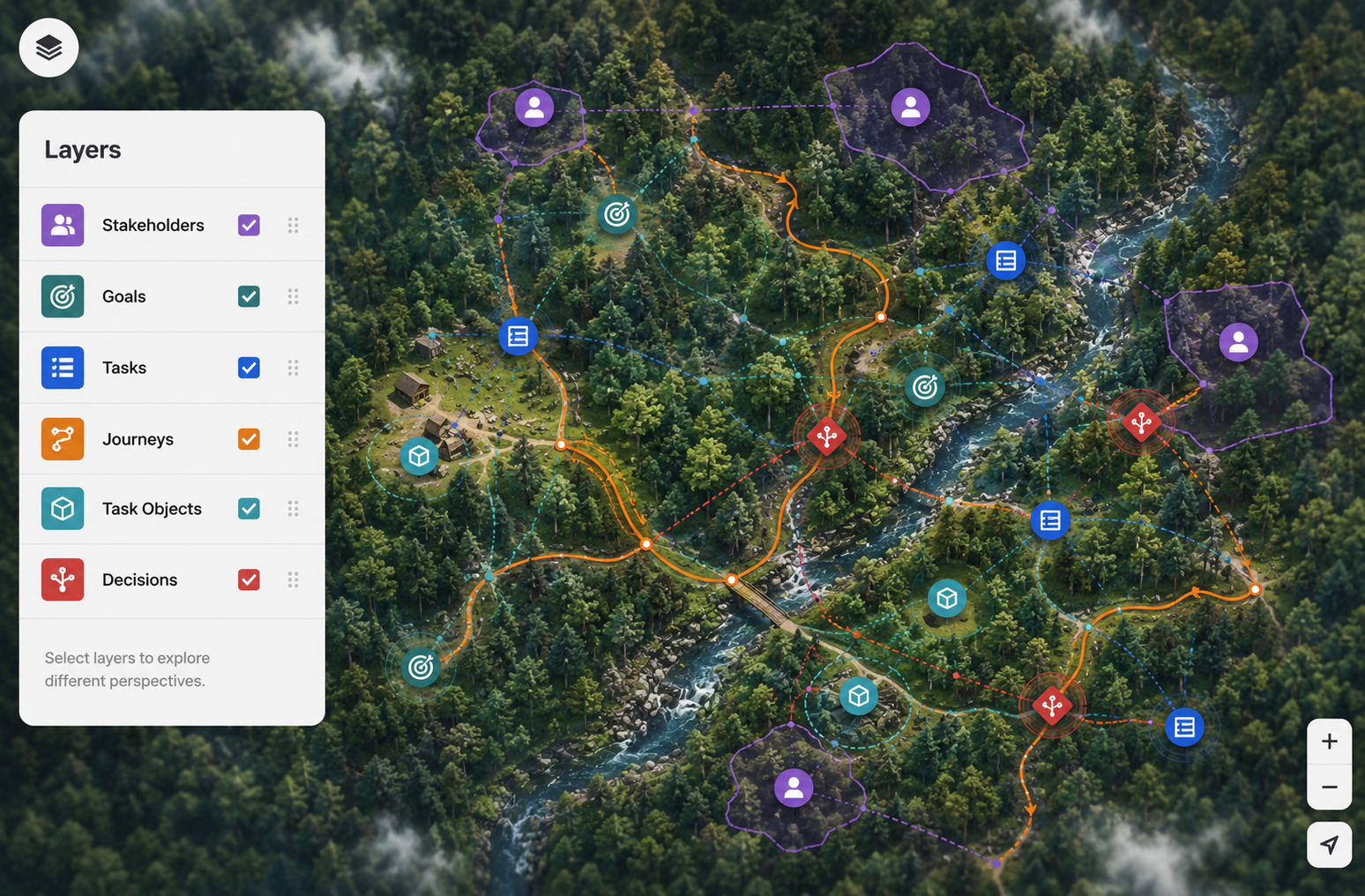
A different approach is to model the problem space first. A human-centered reference model can capture the fundamental entities and relationships within the context of use before individual deliverables are created. Task models, personas, journey maps, user needs, requirements, user stories, and other research artifacts can then be generated as different projections of this common foundation.
Product Context Analyzer (PCA) operationalizes this approach through a human-centered ontology and an interconnected knowledge graph. Instead of using AI primarily to automate individual deliverables, PCA uses AI to construct an explorable reference model of the problem space from which consistent research perspectives can be derived. User researchers can navigate between these perspectives while preserving their relationships to the underlying context.
This changes the role of AI within ResearchOps. Rather than repeatedly recreating understanding for each new deliverable, teams can establish and evolve a persistent model of the problem space. Existing knowledge and interview data can provide an initial foundation, while empirical field research can be focused on validating assumptions, closing knowledge gaps, and enriching areas where direct observation provides the greatest value. AI-assisted user research thereby becomes a systematic practice for building, exploring, and continuously refining shared contextual understanding.