Innovation Begins at the User Need - Not at the Feature Idea
Abstract
User research is often associated with ethnographic observation and contextual interviews. Yet when research findings are shared, results frequently appear as fragmented insights, summary slides, high-level journey or persona maps, or even early design ideas rather than the original context of use from which user needs actually emerge.
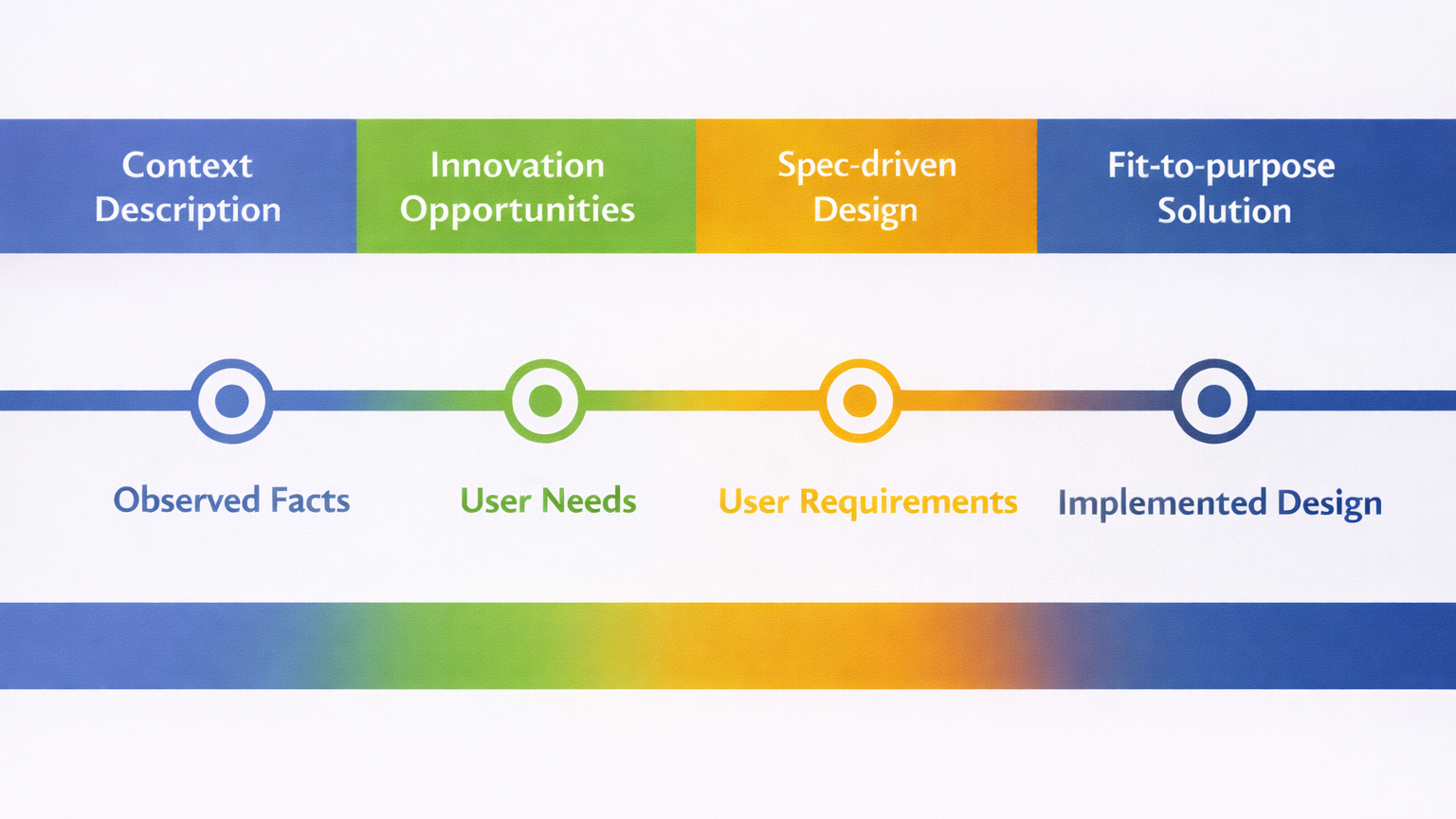
By compressing contextual evidence into summaries, the lineage between observed behavior, implied user needs, and derived user requirements often becomes invisible. Sharing raw videos or interview transcripts does not solve this problem but often worsens it, as the effort required to consume unstructured research material prevents teams from engaging with the underlying context.
To unfold the full power of ethnographic thinking, the context itself must remain accessible. Instead of summarizing research findings, observed behavior, tasks, constraints, and stakeholder interactions can be represented as a structured context model, for example in the form of a knowledge graph linking actors, activities, artifacts, and goals.
Product Context Analyzer (PCA) operationalizes this approach by transforming contextual evidence into an explorable graph of roles, tasks, constraints, and behaviors — exposing what stakeholders must be able to know, accomplish, or avoid in order to succeed. These signals can be interpreted as user needs and translated into explicit user requirements that specify what a system must enable.
AI-powered tools like PCA make it possible to scale this transformation. Context information discovered through ethnographic research or surfaced through structured analysis of language models is translated into explicit user needs and requirements, creating a continuous pipeline from contextual understanding to specification-driven design. User research therefore evolves from episodic insight generation into an infrastructural capability that continuously transforms context into actionable design knowledge.